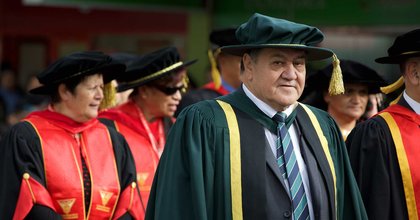
Kāore a Ahorangi Graham Hingangaroa Smith e warea ki ngā whakaaro o ētahi atu mō te āhei, te kore āhei rānei o te whakatutuki i tētahi whakaaro pai. I te tau 2017 i Uropi i whakapakepake ia i tētahi kaitaraiwa waka topatopa ki te rere i a ia ki runga o Mount Olympus – e ai ki ngā kōrero Kirīki, te wāhi ka titiro iho ngā atua ki te ira tangata. Ehara i te mahi māmā, heoi he mahi whai mana. He pānga tō te maunga ki a ia, he tohu hoki ki a ia: Ko ngā matua kēkē o Ahorangi Smith nō Whanganui i pakanga ki ōna rekereke i te pakanga WWII.
"He tini ngā hoia Māori i mate i Mount Olympus. I mauheretia taku matua kēkē ki reira, i a ia e tiaki ana i te tohu o te mātauranga nō Te Uru. Heoi ka pahure ēnei tau maha, e ngana tonu ana mātau ki te tiaki, ki te whakamana i ngā mātauranga Māori ki tēnei whare wānanga. Koia te take i hiahia ahau te rere ki runga – kia kitea katoatia e au."
E mōhio nei a Ahorangi Smith ki tēnei whakahētanga: i tana umanga kua para ia i ngā huarahi i te ao mātauranga kia whai uara, kia whai mana ai hoki ngā mātauranga taketake. I tana tūnga hei Toi Ihorei ki Pūrehuroa, ka tautoko ia i te whare wānanga kia mārama, kia whai hoki i ngā hiahia o ngā tauira, kaimahi, whānau Māori hoki, me te whakatutuki i te hiahia kia ārahina e te Tiriti. Ā te wā kāore ia i te kauhau i āna rangahautanga ki te ao, ka tautoko ia i ngā kaupapa here a te whare wānanga, ka whakaita whanaungatanga me ngā tari kāwanatanga, ngā iwi hoki, me te whakahaere kaupapa hei whakawhanake i ngā kaimahi iwi taketake. He tūranga motuhake tēnei i waihangatia kia whai wāhi te mana, ngā pūkenga, me te whakapono o Ahorangi Smith kia whai hua ngā rangahau ki te ao ngā mahi rangahau, e huri ai te ao.
"Mai i te tirohanga Māori, me hiahia mātau ki ngā putanga whakawhanake o ā mātau mahi – kia rerekē ngā putanga tōrite auau."
Ko te whiu nei ka whakakaha i ngā mahi a Ahorangi Smith, ko ngā whakaaro me rite tonu te huri hei mahi. I a ia e whakawhanake ana i te ariā Kaupapa Māori i ngā tau 1980, ko ia tētahi kaiārahi i ngā mahi whakatū i te Kura Kaupapa Māori – he kura tuatahi e ako ai ngā tamariki i tētahi marautanga ko tōna tūāpapa nō te ao Māori, i tētahi taiao ka whakanui i tō rātau ahurea. I a ia e tū ana hei Tumuaki Māori i Te Whare Wānanga o Tāmaki Makaurau, i whakarite mahere ia hei tautoko i ngā Māori me ngā iwi taketake 500 kia whakatutuki i ō rātau tohu kairangi i ngā tau e rima.
"I te tau i riro i a au taku tohu kairangi, ki taku mōhio ko ahau anake te Māori whai tohu kairangi i te motu. Nō reira i puta au me te kī ka taea kia 500 – i pōhēhē te katoa he tai-wawa. I āhua whitu tau te roa i te mutunga iho, heoi kāore anō mātau kia titiro whakamuri."
Ko ngā hononga a ao o Ahorangi Smith me tōna mana ka hēri mai he mauri hou ki ngā toronga iwi taketake ā-ao o Te Kunenga ki Pūrehuroa. Ko ōna pūkenga i ngā horopaki iwi taketake e taiāwhio ana i Te Moana-nui a Kiwa, pēnei i a Ahitereiria, Alaska, Hawai’i Micronesia me Kānata he mea whakaaweawe. E waru tau ia e noho ana hei upoko i te Educational Policy Studies Department i te University of British Columbia i Kānata, i reira i whakawhiwhia ia ki ētahi tohu kairangi whakahōnore e rua mō āna mahi puta noa i a British Columbia. I tana hokitanga mai ki Aotearoa, i tū ia hei kaiārahi i Te Whare Wānanga o Awanuiārangi, i reira i whai whakauru ia i ngā huarahi Kaupapa Māori ki te wānanga me te hapori whānui.
Kei te mahi tonu a Ahorangi Smith mō te whanaketanga o te iwi Māori. Ko āna mahi ina tata nei e pātai ana i ngā akoranga mō ngā iwi taketake i te mate urutā COVID-19, i te wā i whakahaere ngā tūao Māori i ngā kaupapa tiaki i ngā iwi i te wā kāore te pūnaha i toro ki a rātau. Ko ō rātau angitūtanga i kitea i roto i ngā huarahi Kaupapa Māori, ko te waihanga huarahi ki tua nā roto i ngā uara taketake, ngā pūkenga me ngā mahi.
"He hua pāpori kei roto i ngā uara taketake pēnei i te whanaungatanga, te manaakitanga me te tauutuutu. Ka tautoko tētahi i tētahi, ā, ka whakapunatia ngā rauemi a te takitini. Ki te taka tētahi ka taka mātau katoa. I te tūranga mahi kei ahau i Te Kunenga ki Pūrehuroa ka ngana ahau ki te whakatinana i tēnei huarahi – whakakotahitia ngā pūkenga kei a mātau, e whai hua pai, hua mahi, hua whanake ai hoki. Kei te hiahia ahau ki te whakatipu i ngā pūkenga Māori toki e mārama ana, e whai pūkenga ana e taea ai e rātau te panoni i ō mātau hapori whakaraerae."
Professor Graham Hingangaroa Smith has never let anyone else’s view of what is and isn’t possible get in the way of a good idea.
On a visit to Europe in 2017, he persuaded a helicopter pilot to fly him over Mount Olympus – in Greek myth, the place where the gods sit and look down on mortal human beings. This wasn’t straightforward, but it was important. The mountain had a personal meaning, as well as a symbolic one: Professor Smith’s uncles, who were from Whanganui, had fought on its foothills in WWII.
"A lot of Māori soldiers died on Mount Olympus. My uncle was captured there, defending this great symbol of Western knowledge. And yet all these years later, we’re still trying to defend and validate our Māori knowledge inside the academy. And that contradiction is why I wanted to fly over it – to get the full view of it."
Professor Smith knows this contradiction better than most: he has spent a career in Education Studies championing the value and importance of indigenous knowledge. As Te Toi Ihorei ki Pūrehuroa (Distinguished Professor at Large) at Massey, he helps the university understand and react to what Māori students, staff and whānau want, and move toward its aspiration to be Tiriti-led.
When he isn’t presenting his research around the world, he helps shape university policy, builds relationships with government bodies and iwi groups, and runs programmes to advance indigenous staff. This is a unique role, created to make the most of Professor Smith’s profile, expertise, and belief that scholarship has to get real-world results, forcing change to the status quo.
"From a Māori perspective, we have to be interested in the transforming outcomes of our work – in making a difference around persistent inequalities."
This conviction powers Professor Smith’s own work, which routinely translates ideas into action.
While developing a Kaupapa Māori theory of education in the 1980s, he played a leading role in creating the Kura Kaupapa Māori – primary schools where children study a curriculum grounded in te ao Māori, in an environment that celebrates their culture. As Pro-Vice Chancellor Māori of the University of Auckland, he came up with a plan to support 500 Māori and indigenous students through PhDs in five years.
"In the year I got my PhD, I think I was the only Māori PhD student in the country to graduate. So to come out and say we’d do 500 – well, everyone thought it was impossible. And it took about seven years, in the end, but we’ve never looked back."
Professor Smith’s international connectedness and profile bring a new vitality to Massey’s international indigenous outreach. His scholarship is influential in indigenous contexts around the Pacific Rim, including Australia, Alaska, Hawaii, Micronesia, and Canada.
He spent eight years as Head of the Educational Policy Studies Department at the University of British Columbia in Canada, where he was awarded two honorary doctoral degrees recognising the impact of his work across British Columbia. When he returned to Aotearoa, he took over the leadership of Te Whare Wānanga o Awanuiārangi, where he was able to apply Kaupapa Māori approaches in the institution and the wider community.
Professor Smith continues to work for Māori development. His recent work asks what we can learn from the indigenous response to the COVID-19 crisis, when Māori volunteers ran projects to look after people the official system couldn’t reach. Their success lay in the ways they applied distinctive Kaupapa Māori approaches, building ways forward based on traditional values, scholarship and action.
"There’s a social capital embedded in traditional values of whānaungatanga, like manaakitanga and reciprocity. Everyone tries to support each other and pool all our collective resources. If one falls over, we all fall over. In the job I have now at Ã۶¹ÊÓƵI try to stimulate this kind of approach – to mobilise all the talent we have here, to get positive, proactive and transforming outcomes. I want to help build exceptional Maori scholars who have critical understandings and skills that will enable their work to make a transforming difference in our communities of need."
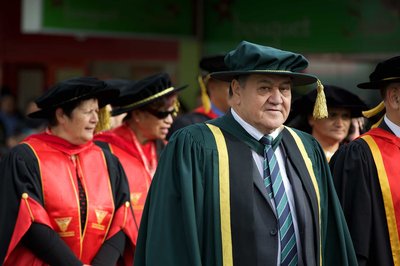
Distinguished Professor Graham Hingangaroa Smith
Ngāti Apa, Ngāti Kahungunu, Te Aitanga a Hauiti, Kāti Māmoe