Mānawatia a Matariki
Watch Professor Rangi Mātāmua's kōrero to celebrate, honour and welcome Matariki.
Introduction to Matariki
Matariki hunga nui, Matariki ahunga nui, Matariki tāpuapua, Matariki Haūkunui, Matariki tohu mate, Matariki takoha nui, Matariki te whetū o te tau!
In customary life for Māori, the rising of the star cluster Matariki (otherwise known as Pleiades) signalled the drawing to an end of one cycle and the emergence of a new one. It also signalled Hine Takurua (the winter maiden) had firmly taken residence upon the land.
At Ã۶¹ÊÓƵwe continue to honour the tradition of Matariki in events on campus and in the community. Take time to look after your family, yourself and those closest and dearest to you. Stop and take time reflect and listen to the natural rhythms of the earth and environment around us, to cook and share food together as whānau and to look after your neighbours.
Matariki events
There are many festivals and events held in the community during Matariki. Many local community groups and councils run activities. Information about these events will be available later in the year.
Celebrating Matariki
Matariki is a specific celebration to Aotearoa New Zealand and honours our season of winter under our stars. It is an opportunity for all New Zealanders to honour our environment and to open ourselves to learning about the traditions of this country which go back hundreds of years beyond colonial settlement.
Matariki is not one specific day it is a season heralded by the rise of the Matariki cluster in the eastern sky in winter. The dates that iwi and hāpu use to mark the rise is dependent on where they are in the country and which particular stars in the cluster they give honour to.
Te Wānanga o Aotearoa has a great .
Ways to celebrate
There is no one way to celebrate Matariki, but events or activities that encourage the following are suitable:
- honouring those who have died in the past year
- reflecting on the past and setting goals for the future
- gathering with whānau and friends to share kai
- events to share knowledge and learning or storytelling
- giving of gifts especially handmade gifts
- indoor activities including playing games, dancing and singing
- engaging with the natural environment
- say "happy Matariki" in te reo Māori by saying "Ngā mihi o Matariki, te tau hou Māori".
The Museum of New Zealand Te Papa Tongarewa, has excellent .
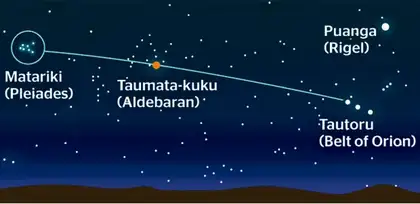
Finding the stars
Look for the Iron Pot.
The bottom three stars of the pot are also called Tautoru (Orion’s Belt). To find Puanga (Rigel) look above the pot until you see the bright star.
To the left of the pot, find the bright orange star, Taumata-kuku (Aldebaran).
Follow an imaginary line from Tautoru across to Taumata-kuku and keep going until you hit a cluster of stars. That cluster is Matariki.
Stars in the Matariki cluster
There are generally considered to be 9 stars although this differs between iwi and hāpu. Each star is seen to hold significance over particular aspects of our lives or the environment.
- Matariki – health and wellbeing.
- Pōhutukawa – those who have died.
- Tupuārangi – connected to everything in the trees – fruits and birds.
- Tupuānuku – food grown from the soil.
- Waipuna-ā-Rangi – rain.
- Ururangi – the winds.
- Waitī – fresh water and fresh water kai.
- Waitā – the ocean and kai moana.
- Hiwa-i-te-Rangi – aspirations for the coming year.
In June/July Matariki can be seen low on the eastern horizon at dawn.
Puanga and Matariki
Some iwi celebrate the star cluster ‘Puanga’ or ‘Puaka’ instead of Matariki at this time of year. Matariki isn’t as clear for some iwi to see from their locality yet Puanga is much clearer in the sky. This does not mean Matariki is rejected. It just means Puanga is given preference. Check with local iwi which star cluster is celebrated in your area.
Puanga is given prominence mainly because some iwi struggle to see Matariki clearly from their locality and therefore look to the next important star near Matariki. That star is Puanga.
This is not a rejection of Matariki as many of these iwi will still refer to Matariki and the other names in the constellation in their tribal narratives – however, Puanga is given preference.
– Che Wilson
Source:
Source:
Ancient traditions behind Matariki
There is much written about Matariki and much is still being unearthed and rediscovered. Each iwi and hapū have their own stories and interactions with Matariki but wherever you are based, the rising of Matariki on the eastern horizon signalled the start of a new cycle of life.
Hope for the new cycle and the promise of new growth, bountiful crops and wild abundance were sown into karakia at Matariki. The balance of life and death, farewelling those who had passed and welcoming a new season of life and abundance were at the forefront of the people’s hearts and minds.
Matariki hunga nui – Matariki of great gatherings
With the earth tilting away from the sun and much of the abundance of Hine Raumati (the summer maiden) dissipating, Māori societies contracted and instead of ranging far and wide they tended to retreat to the warmth and safety of a home base.
Matariki ahunga nui – Matariki an industrious time
It was also a time of significant work and preparation. The harvests of the summer season had been appropriately stored to sustain the people through the winter and the preparations for a new season were being made. It was also a time for whānau to spend time together to engage in all manner of family and community activities. It was a time for sharing, learning and playing and a time for strategy.
Matariki tāpuapua (and haukunui)
With winter came the rain and the land was inundated with wai māori (fresh water). The time of Matariki tāpuapua is seen as cleansing and revitalising the earth and replenishing soil with potential in readiness for the break of kōanga (spring). It is also a significant time for Hine Pūkohurangi (the maiden of the mist) as the cold chill of winter and the warm heart of Papatūānuku collided and people clung close to mother earth for warmth, hence the time of Matariki haukunui.
Matariki tohu mate – Matariki in remembrance of those who have passed on
Matariki was also a time when all those who had passed in the year were remembered, celebrated and bid a final farewell as the earths annual life cycle drew to a close. They were encouraged to travel on to Pōhutukawa, te huinga o ngā mate, the meeting place of the travelling spirits, hence the time of Matariki tohu mate (Matariki in remembrance of those who have passed on).
Matariki takohanui (Matariki the time of giving and sharing)
Matariki was also a time of giving and sharing, sharing time with loved ones, warm meals in the warmth of your whare, by a fire if you were fortunate to have one, or snuggled up next to the heater! A time to share your knowledge and experience with those who seek it, a time to exchange handmade gifts and to relish in the sharing in the gift of time.
For more general information, you can find an excellent
Te Tau Hou Māori – the Māori New Year
Te Matahi o te tau is the new moon after the sighting of Puanga and Matariki (during the Tangaroa phase of the lunar cycle in Pipiri/June). It is the sign of the new year.
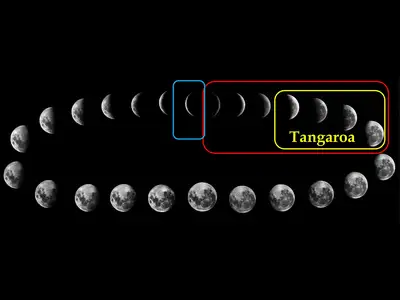
This diagram of the lunar cycle indicates the first new moon after the rising of Matariki (blue), te Mata o te Tau (red) and Tangaroa (yellow).
Whāngai i te hautapu
The ceremonial offering to Matariki. The following karakia is usually recited during the hautapu ceremony. The hautapu is the steam that rises from the kai of the hāngī as a sacred offering to the stars.
Ko kōmako kōmako!
Ko te hautapu e rite ki te kai nā Matariki
Tapa reireia koia tapa!
Tapa kōnunua koi ana tukua!
I auē hī, hā hī!
Ihi ka tū te ihi, ihi ka tū te wanawana
Ki runga i te rangi e tū iho nei, tū iho nei
±áī
E tū Waitī
Ko te wai māori
Tuna heke ki a Wainui
Kia puta ko te ora o Parawhenuamea
Koia
E tū Waitā
Ko te wai tai
Ngaru nui, ngaru roa
Kia puta ko te ora o Tangaroa
Koia
E tū Waipuna-rangi
Ko te ua heke
Kōpatapata mai, hūkerikeri mai, ngaru roa
Kia puta ko te ora o Tāwhiriua
Koia.