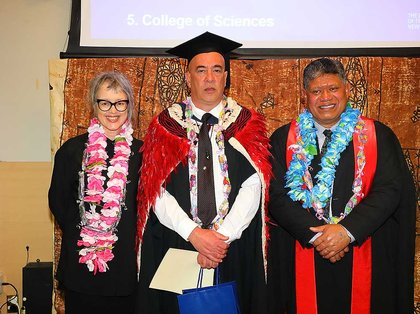
"Whakapiri, whakamarama, whakamana (engagement leads to enlightenment, enlightenment leads to empowerment)."
"When you focus on the dreams and aspirations of whānau the crises solve themselves."
So wrote James Cherrington in his master's thesis, which has set him on a road he himself never dreamed of in his former life working long shifts as a security guard at Oranga Tamariki in Palmerston North.
When James began his Bachelor of Social Work at Massey, he had no internet at home and precious little computer knowledge.
A decade later, he is working on his PhD, fitting his writing into evenings and weekends around his full-time work as a kaiwhakaaraara (Whānau Ora navigator) and his responsibilities as a dad. Kaiwhakaaraara is a title only used by Whānau Ora navigators in the Manawatū, where James lives and works. It translates as "person doing awakening".
James Cherrington’s study journey
When James graduated with his degree, he went straight into his job as a kaiwhakaaraara, a role very few people knew about, he says. That inspired his master’s thesis, which was about providing a wider audience with insight into what a kaiwhakaaraara does and how.
Te Ara Whānau Ora, developed in 2010, is an aspirational, strengths based whānau-centred practice framework used by kaiwhakaaraara, including James, who works in the Te Tihi O Ruahine Whānau Ora Alliance.
Kaiwhakaaraara use this kaupapa Māori approach to improve the wellbeing of whānau as a group. Te Ara Whānau Ora addresses the dreams and aspirations of individuals with in a whānau while also developing a shared whānau moemoeā (dream).
But when the thesis was finished, it occurred to James that he wasn't.
“I had all this rich knowledge and richness from Whānau Ora navigators but I realised something after my thesis was marked – the one thing missing was the voice of whānau.”
And so James's study journey continued. In 2021, nearly a decade after he first began, he started his PhD titled 'Whānau Ora: the voices of Māori and Pasifika whānau'.
“In my PhD I want to privilege the voices of whānau who have experienced having a Whānau Ora navigator walk alongside their whānau. I want to share a whānau perspective about their successes, their transformations, their stories; to prove the efficacy of a Whānau Ora approach, from a whānau perspective. For me it’s not getting a ‘doctor’ in front of my name, it’s about making systemic change.”
From 'academic speak' to 'James speak'
James's own study journey began with “the stress of being 47 and studying in a class of young people”.
“I’d be the guy in the front of the class asking questions all the time and you’d see young ones scowling behind you going ‘oh he doesn’t get it’. I kept asking questions until I got it. I really did think, ‘this isn’t me’ but I forged ahead.”
He says Ã۶¹ÊÓƵsupport networks and an academic writing course offered to mature students, which lifted his grades from B-minus to A-minus, kept him in class and on track.
"I had to simplify the concepts of academic writing for myself. An example I use is the word ‘discuss’ which to me means ‘talk about’ but from an academic perspective it means ‘do a critical analysis and come up with different viewpoints and reference them and then at the end of it come up with your view’."
He also drew on his rich whakapapa of Te iwi o Ngapuhi, te hapū O Ngati Hine, Niuean, Sāmoan, English and Irish, and his father's passion for theatre passed down to James as a child, for giving him the "the gift of the gab and an extensive vocabulary" to get through, and for the work he does now.
With his own experience in mind, during his master's study James became an academic mentor for social work students on the Te Rau Puawai (Māori scholarship) programme. He developed and delivers academic writing workshops for new bursars starting their academic journey.
Now, James also tutors Pacific students voluntarily outside his job and study. James's own workshops on academic writing translate the same terms he once struggled with.
"I talk about turning it into ‘James speak'."
Te ao Māori needs to be lived
James discovered early on in his study journey that his Māori and Pasifika world view did not match what academia was asking of him, and he struggled to find academics who wrote from that perspective.
As his academic network grew, he built up a library on his memory stick of academic references that backed his te ao Māori view and it proved a turning point. “For one assignment I got an A+ and the marker said, ‘I don’t agree at all with your viewpoint but you wrote it so well academically’.”
“In my academic journey as a Māori Pasifika person I was always looking for something that resonated with me and who I am. Every paper starts with a theory and a model and, if you’re really lucky, lecturers would provide us with a Māori or Pacific approach to the theory or model. I remember one assignment I wrote about behavioural theorists and we had to choose one and critique it. I got an A for the assignment but on the last line I wrote, ‘however I still struggle to see the world through the eyes of the dead Frenchman’.”
Times, James says, are beginning to change, but he’s hopeful for further growth in the depth of understanding of te ao Māori in academic areas such as social work and psychology.
“That was one of my dreams for my master's – how we combine te ao Māori with Western concepts to support whānau.”
That includes enriching academia with more authentic Māori engagement, far beyond the one noho marae he was taken on during his four-year social work degree.
“For many social workers that are non-Māori that’s their only experience. I think in all helping professions they need to create one event at least every semester – go do a te reo paper, go do kapa haka. If you learn the language you learn the deepness behind each word. Mana doesn’t just mean respect, there are so many versions and meanings of it."
"By engaging in opportunities to live in a Māori world – going to kapa haka, going to stay on a marae and helping out on the marae – you get a better experience on how to engage with whānau.”
Another stumbling block James found was the concept of proving his cultural competency to engage with Māori for his social work registration.
“As a Māori male at 52 years of age I had to fill out a form to prove my cultural competencies, which is a bit insulting. Te ao Māori can’t be taught as theory, it needs to be lived.”
Missing voices
James's PhD explores how success is measured in te ao Māori and Pacific communities is different from a Western view, which relies heavily on statistical evidence.
Literature reviews indicate to James that Whānau Ora – which uses seven set outcome areas to build a plan for whānau – works, but the way Whānau Ora outcomes are measured seldom includes the narratives of whānau for policy makers and funders to consider.
“We’ve got the mega-ministries, which I don’t believe are achieving the same outcomes as Whānau Ora. One of the biggest issues is, how do you measure an outcome?"
On the seven Whānau Ora outcome areas, James says: "We can provide data on healthy lifestyle, economic security – the whānau set the tasks and the goals. We can prove from data that they’re achieving those but that doesn’t give you a picture of the change and what’s happened for whānau.”
To partially answer the question, Whānau Ora commissioning agencies have come up with a figure of social return on investment. Pasifika Futures, in their 2020 report, put it at $1 of investment for $43 of return, says James. It’s a big number, but not one that captures, or measures, the transformation for whānau.
“That’s almost a billion in return, and about getting people into work. What’s the change in the whānau though? That’s the bit of the equation I’m passionate about in my thesis – the voices of Māori and Pasifika whānau.”
Finding the gold among whānau
James’ interview with a 70-year-old kuia, whaea Mirika, brought a lot of wisdom and knowledge that he used in his master’s thesis, and revisits in his work now.
“She said, it’s about finding the gold among whānau so they become the stars in their own movie.”
James says it's key to not just work with individuals that are referred, but with the whole whānau. It's also vital for many whānau to be introduced to the power of creating āhurutanga (safe space for kōrero), and to describe their dreams and aspirations within that.
He asked one 11-year-old boy to do just that.
"He said 'I want a new bike 'cos my bike’s pakaru. I want to go on school camp because mum and dad have never afforded it. And I want my dad to stop hitting my mum'. The fact that that boy could share that, it blew the dad away."
Eighteen months later, both parents had completed courses to improve their whānau dynamics, they were in employment and "the boy got all of his dreams and then the whānau graduated".
He also worked with a whānau with parents who had a longstanding cycle of violence stemming from mental health issues, followed by stints in prison.
“[The father] would talk about the merry-go-round he’d been on for more than a decade. He knew a lot of te ao Māori but he never accessed it. He knew what āhurutanga was but didn't use it in his whare. The strengths to make his home a safer better place already existed in him but he didn’t access them. It took tautoko and advocacy in court and collective impact connections that I have, and assisting him and his whānau to develop a plan and regular actions that would provide them with āhurutanga in their whare.”
The problem, says James, is that these stories aren't being reflected in the system. "How do you measure that outcome? You can’t see it on that data. You can’t see the transformation of that whānau in the data. I’ve seen change in whānau, but the system is not really changing.”
Dreams, not deficits
Helping professions tend to work across crisis intervention – telling people what to do – and that needs to change, says James.
He’s worked on a collective impact initiative – where Government agencies and partners work alongside whānau for better outcomes – for more than five years. It’s an approach that brings agencies into one room with whānau, instead of running from one appointment to the next, meeting with agencies that have their own requirements and are not working collaboratively to assist whānau to achieve positive outcomes.
“Everything we do at Whānau Ora, where whānau can share their dreams and aspirations with everyone in the room, is focused on empowerment and self-determination of whānau. Everything is about their moemoeā, their dreams and aspirations. That’s why I thought well okay, as far as navigator goes, we know this works. I’ve been doing this mahi for five years and seen huge transformations in Māori. Our process is, ‘stuff the system what can you do to achieve this dream’. We’ll just do the brokerage of bringing the services to those people.”
James currently has 12 agencies and partners working in this way in his home region, the Manawatū, but wants to see collective impact taken to scale, tailored to each community.
James has seen huge success with the collective impact model, including a real pathway to home ownership for low-income whānau. It's that success he wants to see throughout every community, not ongoing focus on what's going badly.
“At the start of my master’s I wrote: 'When you focus on the dreams and aspirations of whānau, the crises solve themselves. Crisis interventions are taken from a deficit perspective because they focus on what is wrong with whānau instead of what matters to whānau.'"
“I’ll sit there with a whānau and say, ‘what’s good about drugs?’. They’ll say, ‘it helps us cope and I can escape’. I’ll say, what’s not good about drugs? ‘Oh I have no food for the kids and we fight over money.’ And then we’re back to, how would you like it to be? In three to five minutes we’ve gone from crisis to aspiration.”
"I have yet to meet any whānau who dream of poverty, physical or mental ill health, substance abuse or family harm."
While James focuses on helping whānau reach their dreams – a pathway into their own homes, out of perpetual cycles of violence, into employment – James dreams about a day when other help professionals would strive to be like Whānau Ora navigators.
“I’ve seen real sustainable change occur within whānau so my kōrero is how can I contribute to that systemic change, where systems impact whānau. If I can write in an academic space that gets the policy people thinking differently, then wicked.”
He hopes to complete his PhD before he’s 60 – and then, continue his work at Whānau Ora. “I don’t yet think of myself as a researcher or academic, I am a 56-year-old kaiwhakaaraara who works in the frontline with Māori and Pasifika whānau."
"Historically kaiwhakaaraara (person doing awakening) stood as sentinels at the front of a pā. They challenged people approaching the pā and woke those inside the pā. I’m awakening the dreams and aspirations of whānau but also awakening te korowai o te ao Māori (the protective cloak of a Māori world). It seems simple, but it takes a skilled workforce.”

James Cherrington
More information
Thesis title
Whānau Ora: the voices of Māori and Pasifika whānau.
Supervisors
Research links
Media and news
Published 25 January 2022.