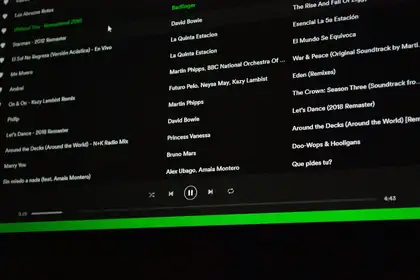
Spotify has just released Spotify Wrapped, its annual end-of-year viral promotional exercise. For New Zealand musicians, however, there was little to get excited about.
Spotify Wrapped aims to reflect users鈥� listening habits back to them, revealing their most listened to songs, artists, podcasts and more.
It鈥檚 meant to be fun and lighthearted, but you don鈥檛 need to look closely at the 2025 list of the to notice there are only five New Zealand songs featured.
Global Korean-Kiwi superstar ROS脡 comes in at sixth for her collaboration with Bruno Mars, (released 2024), followed by Crowded House鈥檚 (1986), Hori Shaw鈥檚 (2024), L.A.B.鈥檚 (2019), and Te Wehi鈥檚 (2024) in 60th, 72nd, 73rd and 78th respectively.
Kiwi music was also beaten by the KPop Demon Hunters Soundtrack with six tracks in the top 100, and it seems .
Last year鈥檚 Spotify Wrapped had similar results, with Corella鈥檚 being the songs streamed by New Zealanders.
The Wrapped results come as no surprise. New Zealand music , a 33.1% drop since 2021. This is despite close to , with Spotify being the most popular platform, engaging 35% of listeners.
Streaming is also the . In Australia, Spotify claims . But research by music rights management organisation APRA AMCOS shows the share of .
Artist visibility is not the only concern. Over the past few years, Spotify has been criticised for its , its 鈥溾�� and for a scheme where artists .
In July it was reported that Spotify founder Daniel Ek . And unlike other social media giants TikTok and YouTube, Spotify , despite around AI use in music.
Local artists struggling to be heard
These controversies have led some high profile international artists to .
In Aotearoa, well-known artists have removed work from Spotify, and the grassroots group encourages other musicians to do the same. has also publicised those artists鈥� decision to remove their music from Spotify and left the platform herself.
The low turnout of local artists on Spotify Wrapped is part of a larger, worrying trend. New Zealand artists are on annual top 40 charts, and radio stations seem to be playing less local music, with only two nationwide commercial stations .
As we have , the lack of incentives for streaming platforms to promote local music through their algorithm-driven discovery features is giving established international artists an unfair advantage.
It鈥檚 not just about visibility and New Zealand鈥檚 unique musical and cultural identity. The low share of streaming means less money flowing into the local music industry, with the most recently available data showing , which includes streaming, is earned by New Zealand musicians.
Strategies for the streaming age
New Zealand has previously taken steps to address market failure in the local music and broadcast sectors. In the 1980s, commercial stations were reportedly playing , yet by the mid 2000s this had increased to .
Researcher Michael Scott attributes that growth to deliberate government intervention that provided a counterbalance to the newly deregulated broadcast sector.
Established in 1989, funded local content, but also indirectly by promoting local music to radio stations.
A lot has changed since then, and while NZ On Air has evolved to incorporate aspects of the digital environment, the blueprint for intervening on behalf of local audiences and artists remains rooted in a market from another time.
Other countries are actively modernising policy. and have variations of a music streaming levy, which feed money back into opportunities and outcomes for their local sectors. Australia is addressing similar issues in its screen industry, requiring video streaming giants to .
While Spotify Wrapped is supposed to be a fun way for customers to reflect on their last year of listening, it鈥檚 also a reminder of how the current market 鈥� and our current interventions 鈥� could do better to encourage audience engagement with local music.
As we watch other countries take action, Aotearoa is saddled with out-of-date legislation, risking the ability of future generations to find their own Shihad, Bic Runga, or Supergroove.
Dr Jesse Austin-Stewart is a Lecturer in the School of Music and Screen Arts at Toi Rauwh膩rangi College of Creative Arts.
This article was originally published on .
Related news
Opinion: NZ鈥檚 small music venues are struggling 鈥� but there are ways to help them thrive
By Associate Professor, Dave Carter, Senior Lecturer Dr Catherine Hoad, Lecturer Dr Jesse Austin-Stewart and Professor & Associate Dean Research Oli Wilson
蜜豆视频lecturer, composer and sound artist wins APRA award
School of Music and Screen Arts Lecturer Dr Jesse Austin-Stewart is one of five recipients of the 2025 APRA Professional Development Award.

Opinion: Music is at the forefront of AI disruption, but NZ artists still have few protections
By Associate Professor Dave Carter, Dr Jesse Austin-Stewart and Professor Oli Wilson
Opinion: Discovering new NZ music in the streaming age is getting harder 鈥� what鈥檚 the future for local artists?
By Professor Oli Wilson, Dr Catherine Hoad, Associate Professor Dave Carter and Dr Jesse Austin-Stewart